On-line monitoring of product attributes in DSP: upping the game

June 27, 2024
Wyatt Technology’s ultraDAWN™ real-time multi-angle light scattering (RT-MALS) instrument provides in-line or on-line monitoring of key product attributes – including molar mass, size, titer and payload – in downstream processing (DSP). It is used to characterize and control DSP of biologics like therapeutic proteins, viral vectors or polysaccharide conjugate vaccines, as well as nanoparticles like LNPs or liposomes. The central hub for MALS-based PAT is OBSERVER™ RT-MALS software. In June 2024, Wyatt released version 1.6.0 of OBSERVER, a primary feature of which is support for an Arc™ Premier BSM-R binary pump when performing on-line monitoring. The BSM-R offers greatly improved performance relative to the quaternary pump utilized previously for on-line RT-MALS.

The ultraDAWN monitors product attributes in real time for optimization and control of various downstream processes.
In/on/at-line PAT: a primer
Process analytical technologies (PAT) for monitoring DSP operations are, in general, configured either in-line, on-line or at-line. These approaches are differentiated by the level of integration with the processing skid and by the response time delay (RTD), i.e. the time that elapses between an aliquot leaving the process and being measured.
- In-line means full integration with the skid, and continuous measurement. This can be a probe inserted via a port to the process environment, e.g. a bioreactor. For a flowing process such as preparative liquid chromatography, the entire product stream—or a portion that is passively diverted—may flow through an in-line PAT instrument. The RTD is determined only by the instrument response time, typically on the order of seconds. Product is never wasted for in-line PAT.
- On-line means partial integration with a skid, and continuous measurement. An auxiliary pump actively diverts a small slipstream from the process vessel or main process flow to the PAT instrument. The RTD is increased by the transport time, which can add tens of seconds to a couple of minutes, though the measurement frequency is still on the time scale of seconds. Depending on the PAT instrument and sterility requirements, the slipstream may be returned to the process or discarded to waste.
- At-line is the lowest level of integration with the skid. An auxiliary pump or other liquid handling device periodically removes aliquots from the process and transfers them to the PAT instrument, where measurements may take minutes or more. In some cases the removal, transport and sample prep (such as dilution) may be manual.
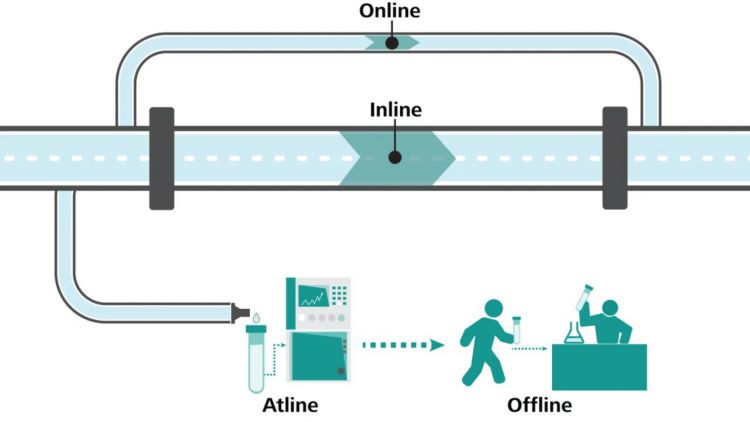
Reference: https://metrohm/blog/on-in-at-offline/
At-line PAT is the most common in biologics DSP, as this mode offers the highest degree of flexibility and depth of analytics, including sophisticated sample preparation, sample storage for later analyses and chromatographic separations. It is optimal for deep, information-rich characterization and control of slowly-evolving unit operations, or for assaying just the final state of the product. The PATROL™ UPLC™ Process Analysis System is a good example of a PAT system that encompasses the many benefits of at-line PAT for DSP of biologics.
On the other hand, in-line and on-line PAT offer simplicity, integration and speed of response, which makes them more suitable than at-line PAT for characterization and control of rapidly evolving downstream processes. The ultraDAWN real-time multi-angle light scattering (RT-MALS) instrument is a breakthrough in-line/on-line PAT instrument for DSP of biologics and nanoparticles. It provides continuous measurements of product attributes such as molar mass, size, physical titer and full capsid ratio for modalities like therapeutic proteins, monoclonal antibodies, viral vectors, LNPs and polysaccharide vaccines.
With in-line RT-MALS, analyses may be performed as rapidly as every 0.2 seconds, capturing fast-eluting peaks and enabling dense characterization and control of such processes. Application note AN8008: Real-time monitoring and control of AAV enrichment by RT-MALS describes in-line operation of RT-MALS to accelerate the development of an anion-exchange chromatographic process to discard empty capsids while retaining full capsids. The ultraDAWN is suitable for flow rates up to at least 150 mL/min, meeting the needs of most bench-scale preparative FPLC and other early process development equipment.
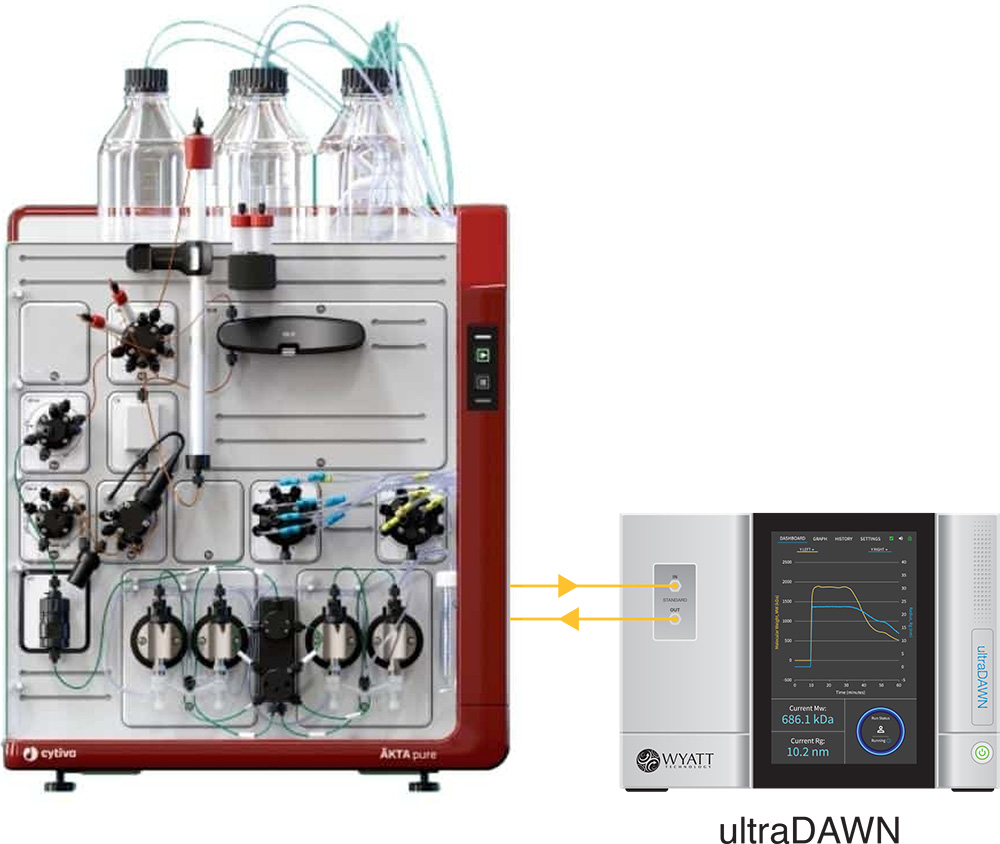
ultraDAWN configured in-line with an ÄKTA™ pure FPLC system.
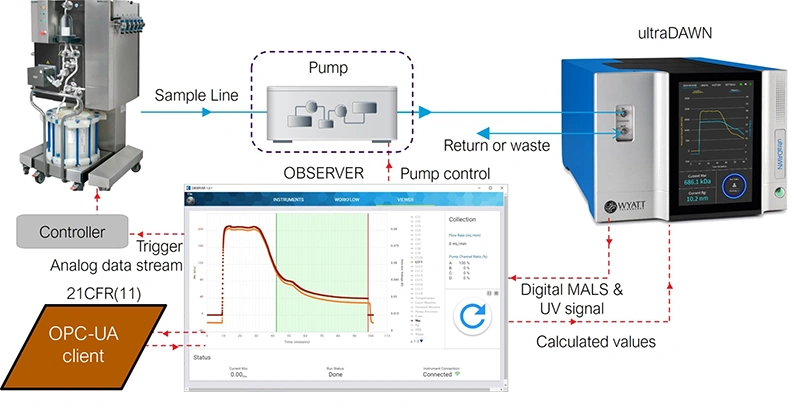
On-line RT-MALS combines an ultraDAWN with an auxiliary pump to draw sample from the process unit (here an ÄKTA™ ready preparative LC system). OBSERVER software orchestrates the measurements, sychronizing with the chromatography steps, calculating product attributes and feeding results back to the process controller such as UNICORN™ software or an OPC-UA client.
Use cases for on-line RT-MALS
There are several reasons why on-line monitoring using an auxiliary pump may be necessary or preferred over in-line monitoring.
- No flow: Continuous or semi-continuous sampling from a static vessel such as the surge tanks/reservoirs feeding a homogenizer, ultra-filtration/diafiltration (UF/DF) system or batch blending system requires a pump.
- High flow: If the inherent flow rate of the process is too high to pass through the ultraDAWN, on-line sampling enables continuous, high-frequency measurements.
- Dilution: In some cases the product must be diluted for proper analysis by light scattering, and this can be accomplished with a binary or quaternary pump. Examples where dilution is needed are reduction of turbidity in essentially opaque solutions, or reduction of macromolecular interactions when product concentration is high and/or solvent ionic strength is low.
- Filtration: In some cases the product must be filtered for proper analysis by light scattering, and this can also be accomplished with a pump and in-line filter.
- Versatility: With the on-line configuration set up to attach to tee connectors inserted at multiple sample points, it is easy to move an RT-MALS system so as to monitor different positions in the process. Since it is not tightly integrated with the process skid, and sampled product may be discarded, sterility considerations may have reduced criticality.
Advantages of the Arc Premier BSM-R binary pump
The two key performance aspects of an auxiliary pump for RT-MALS are RTD and accuracy of dilution. These are impacted by the pump architecture. A quaternary pump uses a single pump head with a proportioning valve, while a binary pump uses two independent pump heads. The BSM-R offers:
- Superior RTD - RTD depends on the volume of tubing between the process and the pump, the internal volume of the pump, the aspiration flow rate, the dilution ratio and the volume of tubing and flow cell downstream of the pump.
- The internal volume of the BSM-R can be a fraction of that of the typical quaternary pump.
- The BSM-R has a higher pressure head than the quaternary pump, meaning that the inner diameter of the process-to-pump tubing can be smaller for a given flow rate, reducing the RTD.
- Superior accuracy - Accuracy of dilution can be compromised when the two solutions have different fluid dynamics arising from different solvent viscosities, tubing i.d. or tubing lengths. Inaccuracy is especially acute for a quaternary pump with a proportioning valve and much less so for a binary pump.
New capabilities for RT-MALS
The BSM-R is a top-of-the-line instrument that has been shown to provide shorter RTD and far more accurate dilution than the quaternary pump used previously with on-line RT-MALS. With the launch of OBSERVER 1.6, these benefits will, in various cases, make on-line RT-MALS more relevant than comparable at-line PAT methods. This will be true in particular for those applications that require the fastest RTD, such as monitoring aggregate levels in the chromatographic purification of monoclonal antibodies, or highly accurate dilutions, such as polymerization/depolymerization reaction monitoring.
In addition to support for the BSM-R, OBSERVER 1.6 provides enhanced integration of online workflows with process equipment, and new post-process analytical capabilities.
Read more about RT-MALS at www.wyatt.com/RT-MALS or contact us at info@wyatt.com to arrange a meeting with our RT-MALS application experts and up your PAT game to the next level.
Application Note AN8008
Real-time monitoring and control of AAV enrichment by RT-MALS
AN8008 describes in-line operation of RT-MALS to accelerate the development of an anion-exchange chromatographic process to discard empty capsids while retaining full capsids.